
A thriving terrace garden needs more than sunlight and water. One of the most important factors behind healthy plant growth is often hidden below the surface: the soil your plant’s roots are growing in.
If you’re growing plants in pots or grow bags on a terrace, the right soil mix for terrace gardening can make a significant difference. A mix that is too compact can restrict air and water movement around the roots, while a mix that drains too quickly may struggle to retain enough moisture.
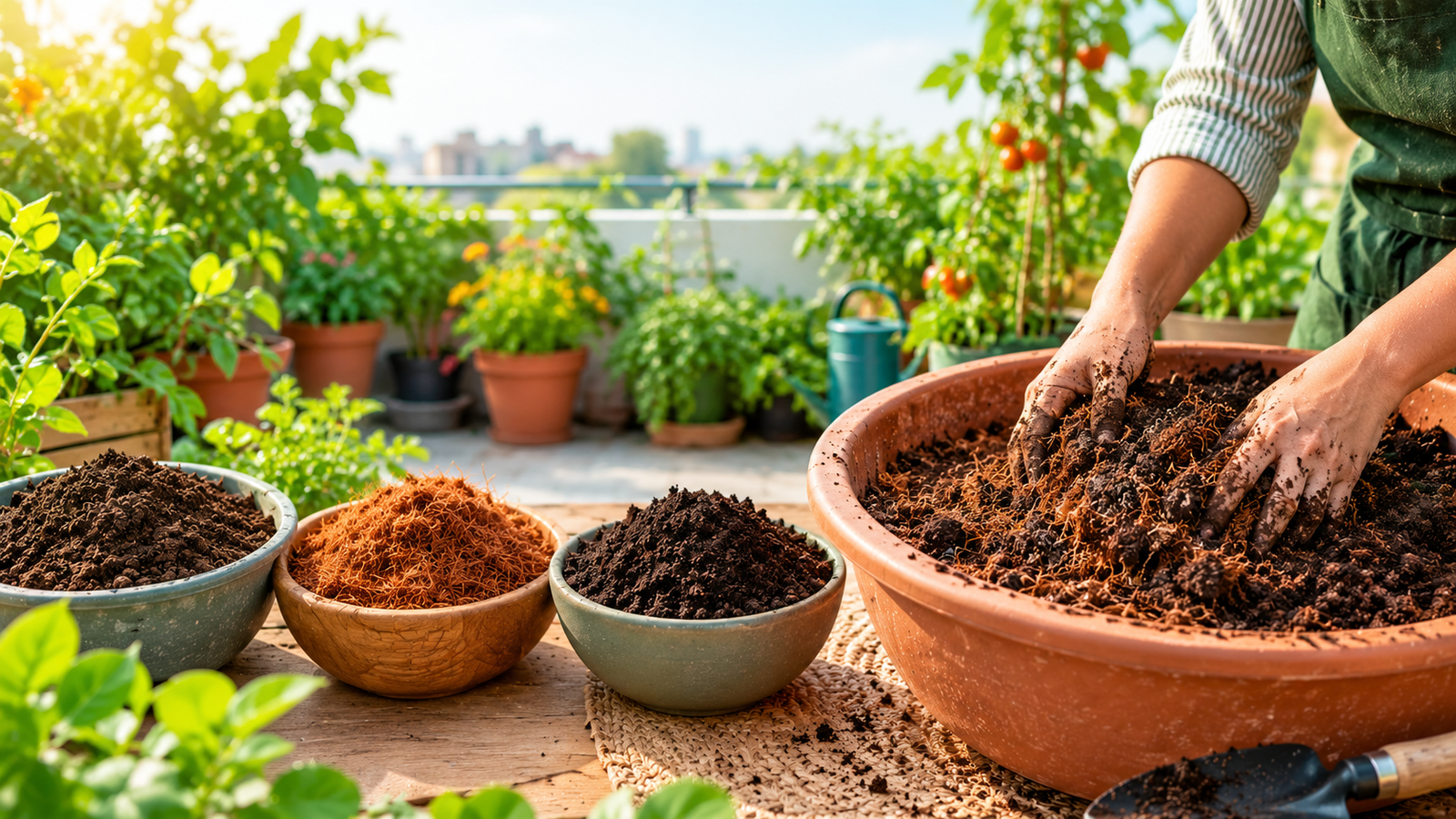
At Vanam, we believe that a good potting mix doesn’t need to be complicated. A simple combination of garden soil, cocopeat and vermicompost can provide a practical starting point for many container plants.
In this guide, we’ll explain the 2:1:1 soil mix, why each ingredient is used, how to mix it properly and how to adjust it for different types of plants.
Why Is Soil Mix Important for Terrace Gardening?
When plants grow directly in the ground, their roots have access to a much larger volume of soil. Containers and grow bags are different. The available growing medium is limited, so its texture, moisture retention, drainage and organic matter become particularly important.
A good container mix should aim to balance three things:
- Moisture retention so the roots don’t dry out too quickly
- Drainage so excess water can escape
- Aeration so roots have access to air
Regular garden soil can provide structure and weight, but using it alone in containers may result in compaction and slower drainage. That’s why combining it with other ingredients can create a more suitable growing environment.
The Simple 2:1:1 Soil Mix for Terrace Gardens
For a basic all-purpose container mix, Vanam’s suggested starting ratio is:
| Ingredient | Ratio | Main purpose |
|---|---|---|
| Garden soil | 2 parts | Structure and weight |
| Cocopeat | 1 part | Moisture retention and aeration |
| Vermicompost | 1 part | Organic matter and nutrients |
The important point is that “part” doesn’t mean a specific measurement.
You can use:
- 1 mug as one part
- 1 bucket as one part
- 1 container as one part
The only important rule is to use the same measuring container for all three ingredients.
So, if you use a bucket:
2 buckets garden soil + 1 bucket cocopeat + 1 bucket vermicompost
This gives you the 2:1:1 starting ratio.
1. Garden Soil: The Base of the Mix
Garden soil forms the base of this potting mix.
It provides the growing medium with structure and weight, giving plants a stable environment for their roots.
However, using garden soil alone isn’t necessarily ideal for containers. In pots and grow bags, soil can become compacted over time. Compaction can reduce the air spaces around roots and slow down drainage.
That’s why garden soil works better as one component of a balanced mix rather than the entire mix.
2. Cocopeat: Keeping the Mix Light and Moisture-Retentive
The second ingredient is cocopeat, made from coconut coir.
Cocopeat helps make the growing medium lighter and more porous. It can also help retain moisture, which is useful for container gardening where the relatively small volume of growing medium can dry out faster.
Its role in the mix is therefore different from garden soil.
While garden soil provides structure, cocopeat helps create a lighter and more aerated texture.
Current terrace-gardening guidance also commonly uses cocopeat as a component of container mixes because of its moisture-retention and lightweight properties.
3. Vermicompost: Adding Organic Matter and Nutrients
The third ingredient is vermicompost.
Vermicompost adds organic matter and nutrients to the growing medium and can support healthy plant development, including flowering and fruiting.
But there’s an important point to remember:
More vermicompost doesn’t automatically mean better growth.
A balanced growing medium is more useful than simply adding increasing amounts of any one ingredient.
This is why the 2:1:1 recipe uses vermicompost as one part of the overall mix rather than making it the dominant component.
How to Mix the Soil Properly
Simply putting the ingredients into a pot isn’t enough. They need to be mixed thoroughly.
Step 1: Measure the ingredients
Using the same container as your measuring unit, prepare:
2 parts garden soil + 1 part cocopeat + 1 part vermicompost
Step 2: Combine all three ingredients
Place the ingredients together in a large container, tub or suitable mixing area.
Step 3: Mix thoroughly
Don’t just mix the top layer.
Use your hands or an appropriate gardening tool to distribute all three ingredients throughout the mixture.
The finished mix should have a loose, crumbly texture rather than sticking together in a dense ball.
The objective is to create an environment where roots have access to both moisture and air.
How to Check Your Soil Mix
You can perform a simple texture check before putting the mix into your containers.
Take a handful of the prepared mix and squeeze it.
If it forms a very wet, sticky ball
The mix may need more aeration and better drainage.
If it is extremely dry and dusty
It may not retain enough moisture.
What are we looking for?
The goal is a balance:
Moisture + drainage + root aeration
This balance is one of the most important principles when preparing a potting mix for container gardening.
Is the 2:1:1 Mix Suitable for Every Plant?
Not necessarily.
This is an important point for beginner gardeners.
Different plants have different requirements, so the 2:1:1 formula should be treated as a basic all-purpose starting mix, rather than a fixed recipe for every plant.
Succulents and Cacti
Succulents and cacti generally prefer a much faster-draining growing medium because their roots don’t perform well when surrounded by excess moisture for long periods.
Their growing medium may therefore need to be modified to provide significantly better drainage.
Vegetables
Vegetable plants can have relatively high nutrient requirements, particularly during active growth, flowering and fruit production.
The basic mix can be adjusted according to the crop and its growing stage.
Plants That Prefer More Moisture
Some plants benefit from a growing medium with greater moisture retention.
For these plants, the proportions and ingredients can be adjusted according to their requirements and your local growing conditions.
Don’t Change Fertilizer Before Checking the Soil
If a plant isn’t growing well, it’s tempting to immediately add more fertilizer.
But that’s not always the first thing you should investigate.
Before changing your fertilizer routine, take a look at the growing medium.
Ask yourself:
- Is the soil becoming compacted?
- Is water draining properly?
- Is the mix staying wet for too long?
- Does it dry out too quickly?
- Are the roots getting enough air?
- Is the plant growing in a mix appropriate for its needs?
Healthy plant growth begins with a healthy root environment.
Why a Simple Soil Mix Can Be Better
Gardening doesn’t always need complicated formulas with a long list of ingredients.
A simple and repeatable mix makes it easier to understand what you’re putting into your containers and how the plants respond.
The 2:1:1 formula gives you a straightforward starting point:
**2 parts garden soil
- 1 part cocopeat
- 1 part vermicompost**
From there, you can modify the mix depending on the plant.
This approach also helps beginners understand an important gardening principle: the goal isn’t simply to add more ingredients; it’s to create the right growing environment for the roots.
Final Takeaway
A healthy terrace garden starts below the soil.
For a simple all-purpose container mix, try the 2:1:1 ratio of garden soil, cocopeat and vermicompost:
2 parts garden soil + 1 part cocopeat + 1 part vermicompost
Mix everything thoroughly until you get a loose, crumbly texture. Then adjust the mix according to the plant you’re growing, particularly for plants such as succulents and cacti that require different drainage conditions.
And remember: if a plant isn’t thriving, don’t immediately assume it needs more fertilizer. Check the soil and root environment first.
Frequently Asked Questions
What is the best soil mix for terrace gardening?
A simple starting mix for many container plants is 2 parts garden soil, 1 part cocopeat and 1 part vermicompost. However, the ideal mix varies depending on the plant and growing conditions.
What is the 2:1:1 soil mix ratio?
The 2:1:1 ratio means 2 parts garden soil, 1 part cocopeat and 1 part vermicompost. You can use a mug, bucket or other container as your measuring unit, as long as you use the same measure for all ingredients.
Why should cocopeat be added to garden soil?
Cocopeat helps make the mix lighter and can improve moisture retention and aeration, making it useful in container and terrace gardening.
Why is vermicompost used in potting mix?
Vermicompost adds organic matter and nutrients to the growing medium and can support healthy plant growth, flowering and fruiting.
Can I use the same soil mix for every plant?
No. The 2:1:1 recipe is a basic starting mix. Plants have different requirements. Succulents and cacti, for example, generally require faster drainage than many other container plants.
How do I know if my soil mix has the right texture?
Take a handful and squeeze it. The mix should not remain as a very wet, sticky ball, nor should it be extremely dry and dusty. A loose, crumbly texture with a balance of moisture and air is the goal.